

Course Overview
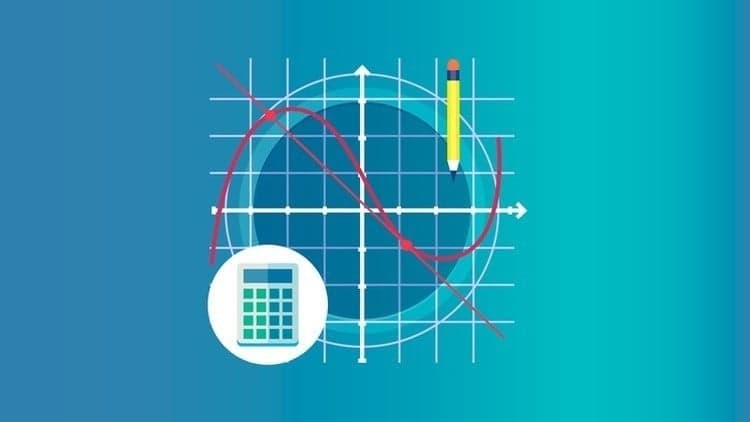
Pre Calculus, Calculus, Trigonometry and Discrete Math
Master Pre Calculus, Calculus, Trigonometry and Discrete Math in one single course with 16 Hrs of Lectures and Exercises
Welcome to this course.
Pre Calculus, Calculus, Trigonometry and Discrete Math are the most important and widely used areas of Mathematics.
Knowledge of "Pre Calculus" helps us to understand Calculus better and is a must to learn before learning Calculus.
"Calculus" is the mathematics of change and because everything in the world is changing, calculus helps us track those changes. It is vital for almost all the important fields like Mathematics and Computing, Data science, Artificial Intelligence (AI) and more.
"Trigonometry" deals with the measurement of sides and angles of triangles and is used in many fields including Video Game Designing, Constructions, Flight Engineering and more.
"Discrete Mathematics" is the math of distinct, countable objects (like integers or steps) rather than continuous, smooth lines (like calculus). It is the backbone of modern technology. It provides the core rules and logic required for programming, digital networks, computer security, and data analysis.
In this course, you will be learning Pre Calculus, Calculus, Trigonometry and Discrete Mathematics. The course is divided into two parts:
Part 1 - Pre Calculus, Calculus and Trigonometry: Under this part of the course you will be learning the following topics in the below mentioned sequence:
Understand FUNCTIONS, learn to Recognize Functions (including the vertical line test) and cite examples thereof; (Precalculus)
Understand the Domain and Range of a function and learn to find them for a given function; (Precalculus)
Understand the Average Rate of Change of a function, learn to find the Average Rate of Change of a function and solve problems based on them; (Precalculus)
Learn about Even and Odd Functions and cite examples thereof; (Precalculus)
Learn to determine if a given function is Even, Odd, or neither; (Precalculus)
Learn about Composition of Functions (composite functions), learn to find the Composition of Two Functions and solve problems based on them; (Precalculus)
Learn about the Inverse Function, learn to find the Inverse of any given Function; (Precalculus)
Understand the Absolute and Relative Maxima and Minima of a Function, learn to Find the Absolute and Relative Maxima and Minima of a given function from graphs; (Precalculus)
Understand TRIGONOMETRY, understand Triangles, the Types of Triangles, and cite examples thereof; (Trigonometry)
Learn the Properties of Triangles and solve problems based on them; (Trigonometry)
Understand Pythagoras Theorem, and use it to solve right triangles; (Trigonometry)
Learn Trigonometric Functions sin, cos, tan and find them for any given right triangle; (Trigonometry)
Learn Trigonometric Functions cosec, sec, cot and find them for any given right triangle; (Trigonometry)
Learn about the Trigonometric Functions of Standard Angles of Trigonometry (namely 0 degree, 30 degree, 45 degree, 60 degree and 90 degree); (Trigonometry)
Understand Complementary angles, Learn to find Find the Complementary Angle of any given angle; (Trigonometry)
Master all the Trigonometric Identities namely, Complementary Angle Identities, Pythagorean Identities, Sum and Difference of Angles Formulas, Negative Angle Identities, Sum to Product Formulas, Product to Sum Formulas, and apply these Trigonometric Identities in solving problems; (Trigonometry)
Learn to Find the Trigonometric Function values of Non-Standard Angles (like that of 75 degree, 22.5 degree, etc.) using Trigonometric Identities; (Trigonometry)
Understand Laws of Sines and Cosines and use them to Find the Unknown Sides and Angles of a given Triangle;
Learn about Similar Triangles; (Trigonometry)
Understand the Conditions for Similarity of Two Triangles; (Trigonometry)
Learn to Prove the Similarity of Given Triangles; (Trigonometry)
Learn the Properties of Similar Triangles and solve problems to Find Unknown Sides and Angles of Similar Triangles; (Trigonometry)
Understand the concept of LIMIT of a Function, learn to Find the Limit of a function using graphs; (Calculus)
Understand One-Sided Limits (left hand and right hand limits, learn to Find One-Sided Limits from graphs and solve problems based on them; (Calculus)
Understand the CONTINUITY of a function, learn to Find the Continuity of a given function from graphs and solve problems based on them; (Calculus)
Detailed understanding of DERIVATIVES; (Calculus)
Learn about the Standard Derivative Formula (the first principle) and use it for finding the derivatives; (Calculus)
Learn the Different Derivative rules such as Derivative of a Constant, Multiplication by Constant, Power Rule, Sum Rule, Difference Rule, Product Rule, Quotient Rule, Reciprocal Rule and the important Chain rule; (Calculus)
Learn to Find the Derivatives of functions using the Different Derivative Rules (with lots of examples on the same); (Calculus)
Learn to Find Derivatives of Trigonometric Functions (Trigonometric Derivatives) (with lots of practice examples); (Calculus)
Learn to Find Derivatives of Exponential Functions (Exponential Derivatives) (with lots of practice examples); (Calculus)
Learn to Find Derivatives of Logarithmic Functions ( Logarithmic Derivatives) (with lots of practice examples); (Calculus)
Part 2 - Discrete Mathematics: In this part you will be learning the very core of Discrete Math. After completing this part of the course, you will be able to:
define a SET and represent the same in different forms; (Set Theory)
define different types of sets such as, finite and infinite sets, empty set, singleton set, equivalent sets, equal sets, sub sets, proper subsets, supersets, give examples of each kind of set, and solve problems based on them; (Set Theory)
define union and intersection of two sets, and solve problems based on them; (Set Theory)
define universal set, complement of a set, difference between two sets, and solve problems based on them; (Set Theory)
define Cartesian product of two sets, and solve problems based on them; (Set Theory)
represent union and intersection of two sets, universal sets, complement of a set, difference between two sets by Venn Diagram; (Set Theory)
solve problems based on Venn Diagram; (Set Theory)
define RELATION and quote examples of relations; (Relations)
find the domain and range of a relation; (Relations)
represent relations diagrammatically; (Relations)
define different types of relations such as, empty relation, universal relation, identity relation, inverse relation, reflexive relation, symmetric relation, transitive relation, equivalence relation, and solve problems based on them; (Relations)
define FUNCTION and give examples of functions; (Functions)
find the domain, codomain and range of a function; (Functions)
define the different types of functions such as injective function (one-to-one function), surjective function (onto function), bijective function, give examples of each kind of function, and solve problems based on them; (Functions)
define and give examples of even and odd functions; (Functions)
figure out if any given function is even, odd, or neither from graphs as well as equations; (Functions)
define composition of two functions; (Functions)
find the composition of functions; (Functions)
define the inverse of a function; (Functions)
find the inverse of any given function; (Functions)
find the domain and range of the inverse function; (Functions)
define The Principle of DISCRETE MATHEMATICAL INDUCTION and use it for Proving Mathematical Statements; (Mathematical Induction)
Mathematical Induction for "Proving the Sum of an Arithmetic Progression"; (Mathematical Induction)
Mathematical Induction for "Proving the Sum of squares of first n natural numbers"; (Mathematical Induction)
Mathematical Induction in "Proving the Divisibility"; (Mathematical Induction)
Mathematical Induction in "Proving the Inequality"; (Mathematical Induction)
Mathematical Induction for "Proving the Sum of a Geometric Progression"; (Mathematical Induction)
Mathematical Induction in a "Brain Teasing Real World Problem"; (Mathematical Induction)
Mathematical Induction for "Proving a result from Geometry"; (Mathematical Induction)
Mathematical Induction in "The Towers of Hanoi"; (Mathematical Induction) and
Learn to use Mathematical Induction to do Computer Program/Algorithm Correctness proofs. (Mathematical Induction)
After completing this course, you will have a very clear understanding of the topics of Pre Calculus, Calculus, Trigonometry and Discrete Mathematics taught in this course with sound ability to solve problems. We recommend this course to everyone who is a Math or a Computer Science student, or any Working Professional in the field of Computer Science, Data Science or any other technical field which involves use of Precalculus, Calculus, Trigonometry or Discrete Mathematics.
Math Hub: Math Instructor, IIT Graduate, Former NVIDIA Engineer
Offer has expired
Verified Coupon